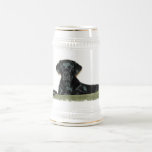
History of Labrador Retriever
The Labrador Retriever breed was developed in the mid-1800's
in England by dog breeders trying to develop the ideal
gun dog. The English Kennel Club recognized the breed
in 1903 and the first Labrador Retriever was registered
with the AKC in the United States in 1917. They have
now become the most popular dog breed in the United
States.
The term "Labrador" is actually a bit of a misnomer.
The dogs originated from the St. John's area of Newfoundland
and were first referred to (incorrectly) as Labrador
dogs by geographically misinformed English people. When
the first fisherman arrived in Newfoundland, there were
probably no native dogs. They most likely imported dogs
from English breeds. Various breeds have been suggested
as possible sources for the St. John's dogs, including
St. Hubert's hound from France, water dogs from Portugal,
and old European pointer dogs.
These dogs were eventually developed into two distinct
lines - a smaller dog and a larger dog. The smaller
dog, used mostly in the fishing boats, was known as
the Lesser St. John's dogs, or the Lesser Newfoundland.
There is a lot of confusion over the actual names of
the dogs, as Newfoundland and St. John's dogs were often
used interchangeably for both the smaller and large
version of the dogs. These dogs were used by the fisherman
mainly for retrieving fish, nets, corks, and fishing
lines. There are often stories of the dogs rescuing
fisherman themselves!
The dogs were developed to have water repellent coat
that was short enough that it would not bring a large
amount of water back in the boat. They were also known
to have high endurance as the fishing trips often lasted
for days at a time. In the late 1800's, Charles Eley
wrote the following in his book, History of Retrievers:
"The first Labrador to reach England swam ashore from
vessels which brought cod from Newfoundland...It was
claimed for them that their maritime existence...had
resulted in webbed feet, a coat impervious to water
like that of an otter, and a short, thick 'swordlike'
tail, with which to steer safely their stoutly made
frames amid the breakers of the ocean.
Other early descriptions exist, including this by the
explorer W.E. Comack: The dogs are admirably trained
as retrievers in fowling, and are otherwise useful.....The
smooth or short haired dog is preferred because in frosty
weather the long haired kind become encumbered with
ice on coming out of the water.
Colonel Peter Hawker wrote: [The Labrador Retriever
is] by far the best for any kind of shooting. He is
generally black and no bigger than a Pointer, very fine
in legs, with short, smooth hair and does not carry
his tail so much curled as the other; is extremely quick,
running, swimming and fighting...
These St. John dogs were imported back into England
from the early 1800's until 1885. In 1885, the Newfoundland
Sheep Act and Britian's Quarantine Act ceased further
importation of the dogs. During the period of importation,
a few kennels regularly imported the St. John's dogs,
including those of Buccleugh and Malmesbury.
The third Earl of Malmesbury (1807-1889) wrote a letter
in 1887 calling the them "labrador dogs" and stating
that the "real breed" may be known by having a "close
coat which turns the water off like oil, above all,
a tail like an otter." The Buccleugh line was developed
at about the same time by the fifth Duke of Buccleugh
(1806-1884) and some of his friends. The Buccleugh line
almost disappeared but was revitalized in 1882 when
the third Earl of Malmesbury gave the sixth Duke of
Buccleugh several of his dogs from the Malmesbury line.
The two separate kennels bred separately for almost
50 years but produced dogs that were very similar. Most
modern Labradors are very closely related to these St.
John's dogs. Buccleugh's Avon is considered the founder
of all Labrador Retrievers.
Colonel Peter Hawker wrote the first written reference
to the breed in his 1814 "Instructions to Young Sportsment,"
and Edwin Lanseer created the first painting of the
Labrador in 1823. The first photograph of the dog was
in 1856 and by 1870 the name Labrador Retriever was
becoming common in England. The first yellow lab was
born in 1899 and the breed was recognized by the English
Kennel Club in 1903. The American Kennel Club (AKC)
soon followed suit in 1917.
In England, the Labrador gained much popularity in the
early 1900's and began performing very well in field
trials. There were also a number of "dual champion"
retrievers in England at this time. Labrador Retrievers
were imported into America during the first World War,
and they enjoyed a huge popularity surge after World
War II. In 1991, the Labrador Retriever took over as
the most registered breed in the AKC and has held that
position for the last 18 years. Over 150,000 Labradors
were registered with the AKC in 2002.
Yellow Labrador Retriever
Although subtype colors were noticed in the
St. John's dogs as early as 1807, the first registered
yellow Labrador was Ben of Hyde, born in 1899. The early
yellow labs were more of a dark yellow, or butterscotch
color. They were actually referred to as "golden" for
a short time. Over the 19th century, a preference for
the lighter shades of yellow developed and more breedings
were done to develop this color. The interest in the
darker shades of gold and fox red were reignited in
the 1980's.
Chocolate Labrador Retriever
The chocolate color was recognized as a a distinct
shade in the 1900's. Jack Vanderwyk has a database (on
LabradorNet database) that traces the origin of all
chocolate labs back into the 1800's. There was also
a certain degree of interbreeding with Chesapeakes and
Flatcoats in the 1900's.
About the Author
The author is a labrador enthusiast who hopes to one
day develop the next dual
champion labrador retriever.
|


 Dog Pound